


Warmth is essential for quality of life – especially in old age
Over the years, the whirlwind on the leash often turns into a relaxed companion. What you don't immediately see from the outside: A lot changes inside a dog's body - and this is particularly noticeable in cold and wet weather.
When the senior shivers: Why older dogs need a coat - even with an undercoat
In this article we will look at:
Why older dogs in particular should wear a coat in rain and cold weather
Why a coat can also be useful for dogs with an undercoat
Why THEO & EMMA coats are particularly suitable for senior dogs
[callout coral | Note] This article is not a substitute for veterinary advice. If your dog shows pain, severe trembling, or significantly altered behavior, please have them examined by a veterinarian.[/callout]
Why older dogs should wear a coat in rain and cold weather. How a dog's body changes with age
The bodies of older dogs function somewhat differently than those of young dogs. Typical changes include:
[check] Thermoregulation becomes more difficult [/check]
Senior dogs often can no longer maintain their body temperature as stably as before. Metabolism and circulation slow down, and the body reacts more sluggishly to temperature changes.
[check] Less muscle mass = less "built-in heater" [/check]
Muscle mass decreases with age - this is well documented in dogs and unfortunately part of the normal aging process. However, less muscle means less heat production with the same amount of movement.
[check] Arthritis and joint problems [/check]
Many seniors suffer from joint changes. Cold and especially wet-cold weather can aggravate joint problems, make movements stiffer, and cause the dog to be reluctant to get up or go up stairs.
[check] Altered circulation & metabolism [/check]
Older dogs are less able to "counter-regulate" when they get cold - they shiver longer, get tired faster, and take more time to warm up again.
In short: A senior gets cold faster and recovers more slowly from the cold. They are also more susceptible to ailments.
How to tell if your senior is cold
Typical signs that your dog is cold:
- Shivering or fine muscle tremors
- Tucked-in belly, rounded back
- Tucked tail, "making themselves small"
- Lifting paws, insecure gait
- Your dog suddenly slows down a lot outside or wants to turn back
- After the walk, it takes longer for them to appear "thawed out" again
If you observe several of these points, a coat is not a luxury, but a very useful support - especially in rain, wind and single-digit temperatures.
Why older dogs should wear a coat even with an undercoat
The classic: "But he has so much fur - he doesn't need a coat!"
This may be true for young, healthy dogs with thick fur. For senior dogs, a closer look is worthwhile.
- Fur changes - even in dogs with undercoat
- With age, the coat can change:
- the fur becomes thinner or duller
- the coat change no longer works as reliably
- old undercoat stays in the fur longer, but insulates less well
This means: Just because the dog looks "fluffy" doesn't automatically mean that it's well insulated outside - especially in wet and cold weather.
Undercoat only insulates when it stays dry
The most important task of the undercoat: trapping air and insulating. But if the fur gets wet (rain, wet snow, splash water from the ground), the following happens:
- Water penetrates to the skin
- The insulating air layer between the hairs is lost
- The body loses heat significantly faster
Studies and technical articles on dog clothing and fur insulation confirm that wet fur loses much of its insulating effect and heat protection decreases massively.
[callout oliv Good to know] Wet fur insulates up to 50% less than dry fur [/callout]
A waterproof coat protects the fur from getting soaked - and thus helps to maintain the dog's natural insulation.
Arthritis, Muscle Loss & Cold - An Unfavorable Combination
In many older dogs, several factors converge:
- Joint changes (arthrosis)
- Muscle atrophy - less musculature
- less movement and shorter walks
- poorer temperature regulation
Cold and wetness can exacerbate joint stiffness and pain. Many veterinarians therefore recommend keeping senior dogs - similar to people with joint problems - warm to alleviate the symptoms.
[callout | Good to know] While a coat does not replace therapy, it can keep the dog's large muscle groups (back, shoulders, hips) warm and prevent the dog from "cooling down" during the walk, and make it easier to get started after rest periods. [/callout]
Especially for dogs that are noticeably stiffer after a walk or have difficulty getting up after lying down, it is worth discussing the topic of thermal protection with the veterinarian.
Why a THEO & EMMA coat is particularly suitable for older dogs
Fit advantage: If nothing pinches or constricts, it's simply better to walk
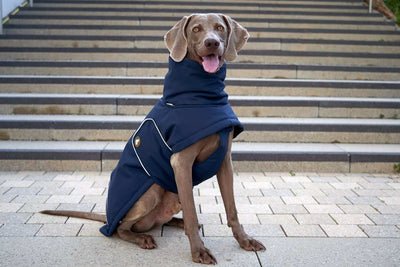
A coat can only help if your dog likes wearing it. For older dogs, a good fit is particularly important:
- Thanks to our Mix & Match system, the back length of the coat can be put together independently of the chest circumference. This allows the coat to be individually adjusted for your dog.
- Our coat also holds without leg straps. Especially with arthritis or sensitive hips/knees, leg straps are often uncomfortable. THEO & EMMA coats do without them – thanks to our ergonomic cut, your dog can walk and sniff naturally without anything pulling or rubbing.
For older dogs, this means: warmth and protection – without compromising freedom of movement.
The right layers for every weather
We recommend the following dog coats for the following weather conditions:
- From wet and cold to windy: Raincoat Cooper
protects against rain, wet snow, and splash water from the belly
keeps the undercoat dry so it can insulate
can be wonderfully combined with the Henry fleece pullover underneath
- From cold to fresh snow: Winter coat Oskar
with insulating filling based on the model of high-quality outdoor jackets
ideal for dogs that get cold quickly or have to stand/lie down a lot
- For the transitional season: Fleece pullover Henry
- For wet and cold conditions: Fleece pullover + Raincoat COOPER
- For very cold-sensitive seniors: Winter coat plus fleece pullover for an extra portion of warmth
This allows you to react flexibly depending on the temperature, weather, and your dog's daily condition.
Senior-friendly handling: quick on, quick off
Older dogs often have difficulty standing for long periods. This means your coat should be quick to put on and take off. Older dogs also often have problems if their legs have to be lifted high.
THEO & EMMA coats are designed so that you can simply pull them over the head and only have to thread the chest strap through the front legs to close the coat. No leg straps and no fiddling around with your dog's hind legs. This protects the joints and nerves, on both sides of the leash.
Visibility & Safety in the Dark
Many walks in autumn/winter take place at dusk. Reflective details on the coat and the option to attach a light (e.g. an Orbiloc Dog Dual) ensure that:
- Your dog is seen earlier in traffic
- You both are more easily perceived on unclear paths.
Especially for dogs that no longer see or hear well, "being seen" is an important safety factor.
Conclusion: Warmth is quality of life - especially in old age
For older dogs, a coat is not a fashion statement, but often a real contribution to more well-being:
- Less shivering
- Less stiffness after the walk
- More relaxed, less painful walks
- More joy in movement - despite rain, wind and cold
- A THEO & EMMA coat combines scientifically sound thermal protection (staying dry and keeping muscles warm) with a fit that adapts to your dog - not the other way around.
Because especially in old age: every cheerful, less painful walk is a little bit of extra quality of life.
Weiterlesen